
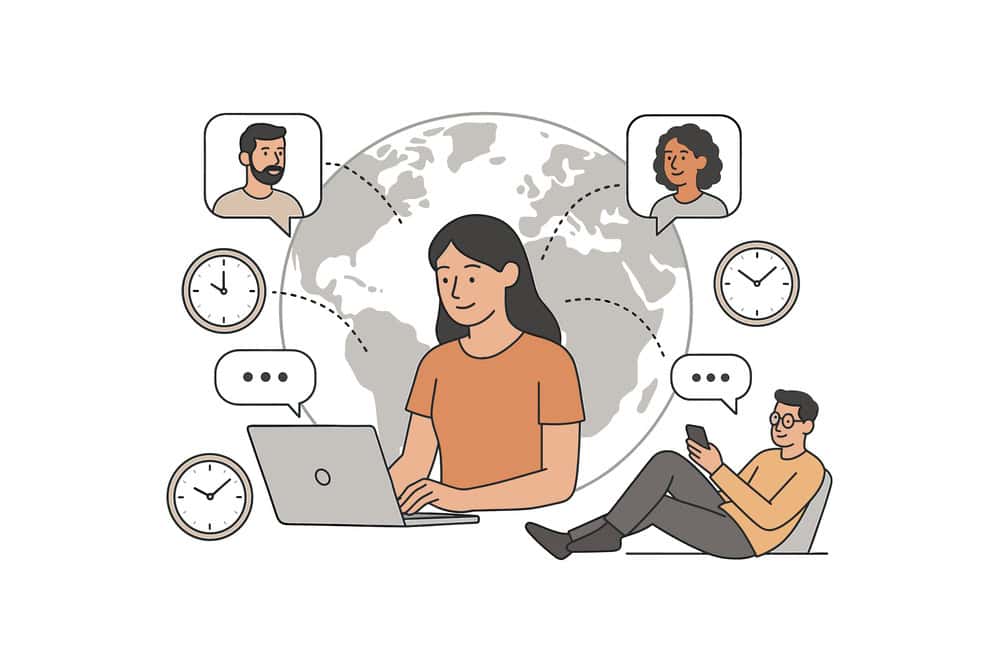
Mastering Remote Collaboration for Filipino Teams and International Clients
In a world where work has gone borderless, Filipino professionals are increasingly at the heart of global teams. From startups in Silicon Valley to agencies in Europe and Australia, Filipino talent powers operations, customer service, marketing, design, engineering, and more.
But there’s one persistent challenge: time zones and expectations.
When your client is in New York, London, or Berlin, you’re often 7–15 hours ahead. Real-time meetings at odd hours, delayed replies, and messages lost in translation can create friction, burnout, and misunderstandings.
This is where asynchronous communication becomes a superpower.
Asynchronous (or “async”) communication means collaboration that doesn’t require everyone to respond in real time. Instead of relying on instant replies, teams use well-structured written updates, recorded videos, and shared documentation so that work continues smoothly—even while others are asleep.
For Filipino teams and international clients, mastering async communication is not just a workflow preference; it’s the secret sauce to sustainable, high-trust, and highly productive collaboration.
Understanding the Filipino Cultural Context
To make async work well, it helps to understand the cultural strengths and challenges that typically show up in Filipino teams.
1. Pakikisama and Harmony
A core Filipino value is Pakikisama—maintaining harmony and good relationships within the group. This often translates into:
- Saying “yes” even when unsure
- Avoiding direct confrontation or disagreement
- Being extra polite, sometimes at the cost of clarity
In synchronous (real-time) conversations—like Zoom calls or live chats—this can mean:
- Team members agreeing even when they have concerns
- Hesitation to bring up risks, delays, or “bad news”
- Important context being left unsaid to avoid awkwardness
2. Hiya and Avoidance of “Bad News”
The concept of Hiya (a sense of shame/embarrassment) can show up as reluctance to:
- Admit mistakes
- Ask for clarification multiple times
- Challenge vague or unrealistic instructions
In global teams where directness is valued—especially in Western cultures—this can lead to:
- Misalignment on expectations
- Surprises close to deadlines
- Undiscussed blockers
3. How Asynchronous Communication Helps
Async, when done well, creates psychological safety:
- Written updates give people more time to think, compose, and clarify.
- It’s easier to be honest and precise in a structured written check-in than in a high-pressure call.
- Documentation makes it safer to say, “Here’s what’s really happening,” backed by facts and timelines.
With the right systems, async communication turns these cultural dynamics from potential friction points into strengths: thoughtfulness, thoroughness, and deep care for the relationship.
The Asynchronous Toolkit: Tools and Best Practices
Async isn’t just “sending messages when you’re free.” It works best when combined with tools and intentional communication habits. Here are some common tools and how Filipino teams and their clients can use them more effectively.
1. Slack (or Similar Chat Tools)
Slack, Microsoft Teams, and similar tools are common hubs for day-to-day communication. Used poorly, they can create chaos. Used well, they become powerful async channels.
Best practices:
- Write low-context messages.Don’t assume the reader “already knows” the situation. Provide enough context in each message so that someone reading hours later can fully understand.
Instead of:
“Done na po.”
Try:
“Task update: I’ve completed the draft of the Q4 social media calendar (Q4_Social_Calendar_v1.xlsx) and uploaded it to the #marketing channel and the Campaigns/Q4 folder in Google Drive. Please review columns D–F for the proposed captions and notes. Target: finalize by Friday PH time.”
- Use threads.Keep related information together so updates don’t get buried.
- Use clear tags and mentions.@channel for all, @person for specific teammates, and add labels like [BLOCKED], [DONE], [NEED FEEDBACK].
- Set expectations for response time.For example: “Non-urgent messages: expect a reply within 24 hours; urgent: within 4 hours, tagged with [URGENT].”
2. Notion, Confluence, or Shared Docs
Documentation tools like Notion, Confluence, Google Docs, or ClickUp Docs are the backbone of async teams. They turn scattered messages into a reliable “source of truth.”
Best practices:
- Create living documentsfor:
- Project briefs
- SOPs (Standard Operating Procedures)
- Onboarding guides
- Meeting notes and decisions
- Use clear sectionslike:
- Objective
- Scope
- Timeline
- Owner
- Status
- Link, don’t repeat.When updating via chat, link to the relevant doc instead of rewriting everything:
“I’ve updated the launch plan here: Launch Plan – PH Team. Please see the ‘Risks’ and ‘Dependencies’ sections.”
- Encourage written decisions.After calls, someone (often the Filipino project manager or coordinator) should document:
- What was decided
- Who owns what
- Deadlines
This helps address cultural tendencies to avoid confrontation later. If expectations are written and agreed, it’s easier to point back and say, “Here’s what we aligned on.”
3. Loom and Video Recording Tools
Tools like Loom, Vimeo Record, or built-in screen recorders are game-changers for cross-cultural teams.
They allow you to:
- Walk through a design, document, or process
- Explain complex issues visually
- Share tone and warmth that might be lost in text
Best practices:
- Keep videos short and focused (3–10 minutes).
- Use a simple structure:
- Context:“This video is to walk you through the landing page changes for the Q4 promo.”
- What you’re showing:“You’ll see the updated hero section, CTA placement, and mobile responsiveness.”
- What you need from them:“Please confirm if the messaging aligns with the UK market tone by Wednesday UK time.”
- Follow up with a brief written summary and key timestamps if needed.
4. Writing “Low-Context” Messages
Many Filipino teams naturally lean towards high-context communication—messages that rely on shared understanding, tone, and reading between the lines.
International teams, especially Western clients, often prefer low-context communication—direct, explicit, and self-contained.
To write low-context messages:
- Answer the W-questions:
- What is this about?
- Why does it matter?
- Who is responsible?
- When is the deadline?
- What do you need from the reader?
Example of a high-context update:
“Hi! Sent the draft already. Let me know. 🙂”
Low-context version:
“Hi [Client Name],
I’ve sent the first draft of the October newsletter to your email and added it to the shared folder (/Content/Newsletters/2025-10).
Key points:
- Target audience: existing B2B clients
- CTA: Book a demo call
- Sections: Product updates, client testimonials, and upcoming webinar
Please review the highlighted sections in yellow (subject lines and CTA text) and share your feedback by Thursday your time so we can finalize and schedule it by Monday PH time.
Thanks,
[Your Name]”
Low-context messages reduce back-and-forth “ping-pong” and help work move forward even when people are offline.
Setting Healthy Boundaries: Avoiding the “Always-On” Culture
One common issue in global remote work is the “always-on” expectation—especially for Filipino teams who want to show dedication and responsiveness.
Without clear boundaries, this leads to:
- Late-night or very early-morning calls
- Checking Slack or email during family time
- Burnout and quiet resentment
Async communication, when used intentionally, can protect work-life balance.
1. Define Working Hours (Per Time Zone)
- Filipino teams should clearly declare their working hoursin PH time (e.g., 9:00 AM – 6:00 PM PH).
- Clients should do the same in their local time.
- Use tools like Google Calendar’s time zone view, or Slack’s status, to make this visible.
Example Slack status:
“⏰ Online: 9 AM–6 PM PH | Best time for calls: 3–5 PM PH”
2. Use Async as Default, Synchronous as Exception
Agree that:
- Most updates, requests, and feedback happen in async form (chat, docs, recorded video).
- Real-time meetings are reserved for:
- Kickoffs and major decisions
- Sensitive conversations (performance, conflict)
- Strategic discussions
This limits the number of late-night calls for Filipino team members and reduces scheduling stress for everyone.
3. Normalize Delayed Responses (Within Agreed Windows)
Instead of expecting instant replies:
- Set a standard like:
- “Non-urgent messages: response within 24 hours.”
- “Urgent: use [URGENT]in the subject and expect a response within 4–6 hours during working time.”
This allows Filipino professionals to be present at home, rest, and avoid checking messages at midnight just to “look responsive.”
4. Encourage Saying “No” or “Not Now” Respectfully
Filipino professionals often struggle to say no, especially to Western clients or managers. Leaders can help by:
- Explicitly stating that it’s okay to push back:
“If a meeting request falls outside your usual hours, please suggest alternatives.”
- Modeling respectful boundary-setting:
“I’ll be offline after 6 PM PH. I’ll respond first thing tomorrow.”
Over time, this builds mutual respect and more sustainable collaboration.
For International Clients and Managers: How to Empower Your Filipino Teams
Async communication is a two-way street. For it to work, international clients and managers need to adapt too.
Here’s how you can better support your Filipino team members:
1. Be Explicit With Expectations
Avoid vague instructions like:
- “Just make it look better.”
- “ASAP please.”
- “Can you handle this?”
Instead, specify:
- Goal:What success looks like
- Scope:What is included (and what’s not)
- Priority:Is this more important than other tasks?
- Deadline:In whose time zone?
Example:
“Please draft a 1,000-word blog post for our US audience about ‘How to Reduce SaaS Churn in 2025.’
- Goal: Educate existing customers and improve retention
- Scope: Focus on practical tips and case examples, no heavy theory
- Tone: Professional but friendly, similar to our last post here: [link]
- Deadline: First draft by Tuesday, 5 PM PH time
Let me know if this timeline works based on your current queue.”
2. Use Written Recaps After Meetings
Don’t rely on memory or assumptions. After calls, send a short recap:
- Decisions made
- Action items (with owners and deadlines)
- Open questions
This written record helps Filipino team members who may have hesitated to ask for clarification during the call.
3. Create a Safe Environment for Questions and Feedback
Invite questions clearly and repeatedly:
- “What’s unclear or ambiguous here?”
- “Is there anything in this plan that feels unrealistic given your bandwidth?”
- “Please disagree with me if you see a better solution.”
Also, reward honesty instead of punishing it:
- Appreciate when someone flags a risk early.
- Thank them for correcting a misunderstanding.
This counteracts cultural tendencies to “keep quiet to maintain harmony.”
4. Respect Time Zones and Non-Work Hours
Simple steps go a long way:
- Use scheduled sendfor emails and messages so they arrive during PH working hours.
- Avoid last-minute requests that assume availability at night or early morning PH time.
- If occasional late calls are necessary, rotate inconvenience—don’t always put it on the Filipino team.
This signals that you see your Filipino colleagues as partners, not just “off-hours support.”
5. Give Feedback That Builds, Not Breaks
When working cross-culturally, tone can be easily misread. Aim for feedback that is:
- Specific:Focus on the work, not the person.
- Balanced:Highlight what’s working, not just what’s wrong.
- Constructive:Offer guidance or examples.
For example:
Instead of: “This is not good.”
Try:
“The structure is solid, but the intro feels a bit generic for our US readers. Can you make the opening more specific to SaaS founders and mention their churn pain points? The middle section where you explain the 3 strategies is strong—let’s keep that.”
This builds confidence and helps Filipino professionals grow into more autonomous, proactive contributors.
Conclusion: Asynchronous as a Shared Skill and Strategic Advantage
For Filipino teams and international clients, asynchronous communication is more than a workaround for time zones; it is a strategic advantage.
When you:
- Understand cultural dynamics like Pakikisamaand Hiya
- Use tools like Slack, Notion, and Loom with intention
- Write low-context, complete, and clear messages
- Set boundaries to prevent burnout
- And, as clients and managers, create a safe, explicit, and respectful environment
—you unlock a new level of collaboration.
Work moves forward while others sleep. Meetings become fewer but more meaningful. Feedback is clearer. Trust deepens.
Most importantly, Filipino professionals can bring the full power of their creativity, diligence, and warmth to the table—without sacrificing their well-being.
Mastering the art of asynchronous communication isn’t just about productivity; it’s about building remote relationships that are sustainable, human, and genuinely world-class.
If you’d like, I can next:
- Turn this into a shorter LinkedIn post or thread, or
- Create a team-ready checklist for async best practices tailored to Filipino + international teams.


